Canon AE-1 Manual: A Comprehensive Guide
Delve into the world of classic photography! This guide offers detailed instructions, troubleshooting, and historical context for the iconic Canon AE-1 camera, ensuring optimal performance.
The Canon AE-1, released in 1976, revolutionized 35mm photography. It was a landmark camera, bringing advanced features to a wider audience through its innovative automation. This guide serves as a comprehensive resource for both novice and experienced photographers seeking to understand and utilize this classic camera.
We’ll explore its features, operation, and maintenance, drawing upon available manuals and community knowledge to ensure you get the most from your AE-1. Prepare to rediscover the joy of analog photography!
Historical Context of the Canon AE-1
Launched in 1976, the Canon AE-1 arrived during a pivotal shift in camera technology. It challenged established brands like Nikon and Pentax, offering microprocessor control – a first for a consumer-level SLR; This innovation simplified exposure, attracting a broader range of photographers.
The AE-1’s success propelled Canon to prominence, establishing them as a major player in the photographic world. Its affordability and user-friendliness democratized photography, leaving a lasting legacy.
Key Features and Specifications
The Canon AE-1 boasts shutter-priority autoexposure, allowing photographers to select shutter speed while the camera sets the aperture. It accepts Canon FD mount lenses, offering a wide range of focal lengths. The camera features a built-in metering system with both spot and averaging modes.
Specifications include a focal plane shutter (2-1/1000 sec), ISO 25-1600 film speed range, and a robust mechanical build. It operates on a 4LR44/PX28 battery.

Understanding the Camera Body
Explore the AE-1’s design! This section details the physical components, controls, and internal mechanisms – shutter and aperture – crucial for operation and maintenance.
Physical Components and Controls
The Canon AE-1 boasts a robust, yet user-friendly design. Key external features include the film advance lever, shutter release button, and exposure compensation dial. The top plate houses the mode selector for shutter-priority, aperture-priority, and manual operation.
Around the lens mount, you’ll find the aperture ring and focusing ring. The camera’s baseplate provides access to the battery compartment. The viewfinder offers a clear view with focusing aids. Understanding each control’s function is vital for mastering the AE-1’s capabilities and achieving desired photographic results.
The Shutter Mechanism Explained
The Canon AE-1 utilizes a horizontally-traveling focal plane shutter. This mechanism consists of two curtains that move across the film plane, controlling exposure time. Shutter speeds range from 2 seconds to 1/1000th of a second, offering versatility in various lighting conditions.
The shutter’s operation is electronically controlled, ensuring accuracy. Understanding how the shutter interacts with aperture settings is crucial for achieving proper exposure and creative effects like motion blur.
Aperture Control and Depth of Field
The Canon AE-1’s aperture is adjusted via the lens itself, not the camera body. Aperture controls the lens opening, influencing both light intake and depth of field. A wider aperture (smaller f-number like f/2.8) creates a shallow depth of field, ideal for isolating subjects.
Conversely, a narrower aperture (larger f-number like f/16) yields greater depth of field, keeping more of the scene in focus. Mastering aperture is key to artistic control.
Loading and Unloading Film
Proper film handling is crucial! This section details the Canon AE-1’s film loading and unloading process, ensuring your photos aren’t ruined by errors.
Film Types Compatible with the AE-1
The Canon AE-1 is remarkably versatile regarding film choices. It readily accepts 35mm film in both cassette formats – standard and quick-load. Black and white, color negative, and color slide (transparency) films are all fully compatible.
ISO speeds ranging from 25 to 3200 are generally supported, though optimal results depend on lighting conditions and desired image characteristics. Experimenting with different film stocks is encouraged to achieve varied aesthetic effects. Always ensure the film is properly loaded to prevent light leaks and ensure accurate exposures;
Step-by-Step Film Loading Instructions
Loading film into the Canon AE-1 is straightforward. First, open the camera back using the film release lever. Insert the film cassette into the right-hand side chamber. Thread the film leader across the camera and onto the take-up spool. Advance the film using the winder, ensuring it catches securely. Close the camera back.
Continue winding and pressing the shutter release until the rewind knob begins to rotate, indicating the film is properly advancing.
Rewinding the Film Correctly
Proper film rewinding prevents damage and ensures complete exposure retrieval. After finishing your roll, press the film rewind button on the camera base. Rotate the rewind crank in the direction indicated by the arrow. Feel for a lessening of resistance, signaling the film is fully back in the cassette.
Open the camera back and carefully remove the film cassette. Avoid exposing the film to bright light during removal.
Exposure Settings and Modes
Master light control with the AE-1! Explore shutter priority, aperture priority, and manual modes for creative flexibility and precise exposure adjustments.
Shutter Priority Mode Operation
In Shutter Priority mode, you dictate the shutter speed, while the camera automatically selects the appropriate aperture for correct exposure. This is ideal for controlling motion – freezing action with fast speeds or blurring movement with slower ones. Set your desired shutter speed using the dial, and the AE-1’s metering system will determine the corresponding f-stop.
The viewfinder displays the calculated aperture. Remember to check if the selected aperture provides sufficient depth of field for your subject. This mode excels in dynamic situations where consistent shutter speed is crucial, like sports or wildlife photography.
Aperture Priority Mode Operation
Aperture Priority mode empowers you to control depth of field, while the camera automatically adjusts the shutter speed for proper exposure. Select your desired f-stop using the aperture ring on the lens. A wider aperture (lower f-number) creates a shallow depth of field, ideal for isolating subjects with blurred backgrounds.
Conversely, a narrower aperture (higher f-number) yields greater depth of field, keeping more of the scene in focus. The viewfinder displays the calculated shutter speed; ensure it’s fast enough to avoid motion blur.
Manual Exposure Mode Explained
In Manual mode, you have complete control over both aperture and shutter speed, allowing for precise exposure settings. Use the camera’s metering system as a guide, observing the needle in the viewfinder. Adjust the aperture and shutter speed dials until the needle centers, indicating proper exposure.
This mode is crucial for challenging lighting situations or when you desire a specific creative effect, overriding the camera’s automatic settings for full artistic control.
Focusing Techniques
Achieve sharp images with the AE-1! Master viewfinder focusing, explore different focusing screens, and utilize the depth of field preview for optimal results.
Using the Viewfinder for Accurate Focus
The Canon AE-1’s viewfinder is central to achieving sharp photographs. Carefully observe the split-image rangefinder at the center; align the two opposing images for precise focus. Microprism collars surrounding the split-image aid in fine-tuning. Remember that focus accuracy depends on your eyesight and proper technique. Practice consistently to develop muscle memory.
Pay attention to the focusing aids, especially in lower light conditions. Ensure your subject falls within the focusing points for optimal clarity. Regularly check focus before pressing the shutter release.
Focusing Screens and Their Impact
The Canon AE-1’s focusing screen significantly impacts your focusing experience. Different screens offer varying focusing aids – split-image, microprism, and matte fields. A New Large Maxxum screen enhances brightness and focusing precision, particularly useful in low light. Screen choice affects how easily you achieve critical focus.
Consider your shooting style when selecting a screen. Brighter screens aid quick focusing, while others prioritize accuracy. Replacing the screen requires careful handling to avoid dust contamination.
Depth of Field Preview Function
The Canon AE-1 features a depth of field preview lever, crucial for landscape and portrait photography. Activating this lever stops down the lens to the selected aperture, allowing you to visualize the in-focus area in the viewfinder. This ensures the desired portion of your image is sharp.
Remember, previewing darkens the viewfinder image. Use it judiciously, especially in low light, to confirm sufficient depth of field before capturing the shot.
Metering System Details
The AE-1’s center-weighted metering system accurately assesses light. Understand its range and utilize exposure compensation for optimal results in challenging lighting scenarios.
Understanding the AE-1’s Metering Range
The Canon AE-1’s metering system operates effectively within a broad range of lighting conditions, typically from EV 3 to EV 18 with a 50mm f/1.4 lens at ISO 100. This allows for accurate exposure determination in diverse scenarios, from bright sunlight to dimly lit interiors. However, extreme conditions – very low or very high light – may require utilizing the exposure compensation dial.
Understanding this range is crucial for achieving properly exposed photographs. The AE-1’s meter displays a needle indicating underexposure, correct exposure, or overexposure, guiding adjustments for optimal results.
Spot Metering vs. Averaging Metering
The Canon AE-1 primarily utilizes an averaging metering pattern, evaluating the light across the entire frame to determine exposure. However, it also offers a spot metering capability, activated by pressing a button near the shutter release. Spot metering measures light from a very small area – approximately 12mm – allowing precise exposure control for specific subjects.
Choosing between these modes depends on the scene. Averaging is suitable for evenly lit scenes, while spot metering excels in high-contrast situations.
Exposure Compensation Techniques
The Canon AE-1’s exposure compensation dial allows you to override the camera’s metering system, crucial for challenging lighting. When shooting bright scenes like snow or beaches, use negative compensation (-1 to -2 stops) to prevent overexposure. Conversely, for dark subjects, employ positive compensation (+1 to +2 stops) to avoid underexposure.
Practice is key! Regularly check your results and adjust compensation accordingly to achieve desired image brightness.
Using Flash with the Canon AE-1
Enhance your photography with flash! Explore compatible units, synchronization speeds, and potentially TTL modes for optimal illumination and creative control with your AE-1.
Compatible Flash Units
The Canon AE-1 utilizes flash units with a dedicated “A” setting for automatic exposure. Canon Speedlites designed for the FD mount, like the Speedlite AL-1 and AL-2, are ideal choices. These units communicate directly with the camera, enabling TTL (Through-The-Lens) metering for precise exposures.
Non-dedicated flash units can also be employed, but require manual settings. Adapters are available to trigger some modern flashes, though full TTL functionality may not be achievable. Ensure proper voltage compatibility and safe synchronization with the camera’s shutter speeds.
Flash Synchronization Speed
The Canon AE-1’s maximum flash synchronization speed is 1/60th of a second; Exceeding this speed will result in a portion of the image being blacked out, as the shutter curtain isn’t fully open when the flash fires.
When using flash, always set the shutter speed to 1/60th sec or slower to ensure complete illumination of the frame. Aperture controls the flash exposure, while shutter speed dictates ambient light capture.
TTL Flash Mode (if applicable)
The Canon AE-1 does not natively support Through-The-Lens (TTL) flash metering. It predates this technology. However, dedicated Canon flash units (like the Speedlite series) can be used in non-TTL modes – typically manual or automatic.
Automatic mode relies on the flash unit’s sensor to regulate output. For precise control, manual flash offers full command over light intensity, requiring experimentation and a light meter.
Troubleshooting Common Issues
Resolve typical AE-1 problems! This section details solutions for shutter malfunctions, metering errors, and film advance difficulties, keeping your camera functioning smoothly.
Shutter Problems and Solutions
Addressing shutter issues is crucial for proper AE-1 function. A common problem is a slow or sticking shutter, often due to aged lubricants. Carefully cleaning the shutter curtain and applying a silicone-based lubricant can resolve this. If the shutter fires inconsistently, check the battery and electrical contacts.
Ensure the film is loaded correctly, as this can also affect shutter operation. For complete failures, professional servicing is recommended, as internal shutter mechanisms are complex. Avoid forceful attempts to operate a stuck shutter, potentially causing further damage.
Metering System Errors
Troubleshooting the AE-1’s metering system is vital for accurate exposures. If the meter consistently displays incorrect readings, begin by checking the battery – a weak battery is a frequent culprit. Ensure the lens aperture is correctly set and the shutter speed dial isn’t interfering.
Dirty light seals can also cause inaccurate readings. If problems persist, a professional calibration may be necessary, as internal components can drift over time. Avoid self-repair if unfamiliar with electronics.
Film Advance Issues
Experiencing difficulties with film advance? First, confirm the film is properly loaded and the leader is correctly engaged with the take-up spool. A jammed film can prevent smooth operation. Check for any obstructions within the film chamber.
If the lever feels stiff, avoid forcing it; this could damage the mechanism. Inspect the rewind knob for proper function. If issues continue, professional servicing is recommended to avoid further complications.

Lens Compatibility and Usage
Explore a world of optics! The Canon AE-1 utilizes the Canon FD mount, offering compatibility with a vast range of lenses for diverse photographic styles.
Canon FD Mount Lenses
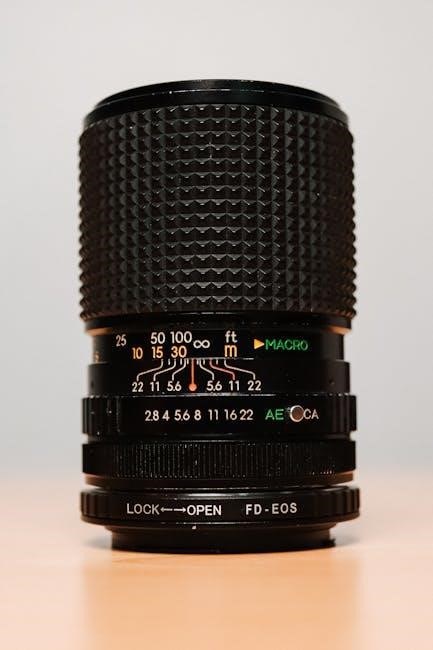
The Canon FD (Focusing Distinctive) mount is central to the AE-1’s versatility. Introduced in 1971, it offered a robust and reliable connection for a wide array of lenses. These lenses span from affordable kit lenses to professional-grade optics, including zooms, primes, and specialty lenses like macro and tilt-shift options.
FD lenses are characterized by a breech-lock mounting system, requiring a twisting motion to attach and detach. While offering excellent image quality, adapting FD lenses to modern digital cameras often requires an adapter, potentially impacting infinity focus.
Adapting Other Lens Types
While the Canon FD mount is native to the AE-1, adapters exist to utilize lenses from other systems. These adapters allow mounting of lenses like those from M42, Pentax K, and Nikon F mounts. However, using adapters often introduces limitations, potentially including reduced functionality or image quality.
Adapters may not preserve all features, such as automatic diaphragm control. Careful research is crucial to ensure compatibility and understand any compromises before adapting non-FD lenses.
Lens Care and Maintenance
Protecting your Canon FD lenses is vital for image quality and longevity. Regularly use a blower to remove dust, followed by a soft lens brush for stubborn particles. For fingerprints or smudges, employ a microfiber cloth with lens cleaning solution.
Avoid harsh chemicals or abrasive materials. Store lenses in a dry, dust-free environment, ideally within a protective case, to prevent damage and maintain optimal performance.

Battery Information
The Canon AE-1 utilizes standard 4LR44 or equivalent alkaline batteries. Ensure correct polarity during replacement for reliable operation and accurate light metering.
Compatible Battery Types
The Canon AE-1 primarily requires a 4LR44 6V alkaline battery to power its light meter and electronic functions. However, several alternatives offer compatibility, including the PX28, V4032, and even combinations of smaller batteries like four SR44 or LR44 button cells wired in series.
Using alternative battery types is possible, but ensure the voltage remains consistent at 6V to avoid damaging the camera’s circuitry. Always prioritize quality batteries from reputable brands for optimal performance and longevity.
Battery Replacement Procedures
To replace the battery, locate the battery compartment on the camera’s bottom. Use a small screwdriver to open the compartment cover. Carefully remove the old 4LR44 battery, noting the correct polarity (+ and -). Insert the new battery, ensuring proper alignment with the markings inside the compartment.
Securely close the battery compartment cover. A loose cover can cause inaccurate metering. Always handle batteries with care and dispose of them responsibly according to local regulations;
Battery Life and Performance
The Canon AE-1’s battery life depends heavily on usage patterns. Expect approximately 20-30 rolls of 35mm film from a fresh 4LR44 battery with typical metering and operation. Frequent use of the light meter, especially in low light, will reduce battery life considerably.
Performance diminishes as the battery weakens, potentially leading to inaccurate exposure readings. Regularly check the battery indicator in the viewfinder and replace the battery proactively to maintain optimal camera function.

Maintenance and Care
Preserve your Canon AE-1’s longevity! Regular cleaning, careful lens care, and proper storage are crucial for maintaining its functionality and pristine condition.
Cleaning the Camera Body
Maintaining a clean camera body is essential for its proper function and appearance. Use a soft, dry microfiber cloth to gently wipe away dust and fingerprints. For stubborn grime, slightly dampen the cloth with distilled water – avoid harsh chemicals or solvents. Pay attention to the film compartment and viewfinder window, ensuring they are free of debris. Regularly inspect the battery compartment for corrosion and clean as needed. Avoid excessive moisture, and always ensure the camera is powered off during cleaning. Careful handling prevents scratches and preserves the AE-1’s classic aesthetic.
Lens Cleaning Best Practices
Protect your investment with proper lens care! Begin by using a blower brush to remove loose dust and particles. Gently wipe the lens surface with a microfiber lens cloth in a circular motion. For fingerprints or smudges, apply a small amount of lens cleaning solution to the cloth – never directly onto the lens. Avoid excessive pressure. Regularly inspect the lens elements for scratches or fungus. Store lenses with caps on in a dry, dust-free environment to maintain optimal image quality and longevity.
Storage Recommendations
Preserve your Canon AE-1 for years to come! Store the camera body and lenses separately in a cool, dry place, away from direct sunlight and extreme temperatures. Utilize a camera bag or case for protection against dust, moisture, and accidental impacts. Remove batteries during prolonged storage to prevent corrosion. Periodically check for mold or mildew, especially in humid climates. Proper storage ensures the camera remains functional and retains its value.
Resources and Further Learning
Expand your knowledge! Explore online manuals, dedicated forums, and repair services to deepen your understanding and maintain your Canon AE-1 effectively.
Online Manuals and Guides
Numerous online resources offer comprehensive Canon AE-1 documentation. Websites host downloadable PDF versions of the original instruction manual, providing detailed explanations of all features and functions. These guides cover everything from basic operation to advanced techniques, aiding both beginners and experienced photographers.
Furthermore, several websites curate user-submitted tips, tricks, and troubleshooting advice, supplementing the official manual. Searching for “Canon AE-1 manual PDF” will yield a wealth of accessible information, ensuring you have the support needed to master this classic camera.
Canon AE-1 Communities and Forums
Engage with a vibrant community of Canon AE-1 enthusiasts! Online forums and photography communities dedicated to film cameras provide invaluable support and knowledge sharing. These platforms allow users to ask questions, exchange tips, and discuss all aspects of the AE-1, from lens compatibility to repair advice.
Connecting with fellow photographers fosters learning and problem-solving. Many experienced AE-1 users readily offer assistance, creating a collaborative environment for mastering this iconic camera and its capabilities.
Repair Services and Support
When issues arise, professional repair services are crucial. Numerous technicians specialize in vintage camera repair, offering expertise for the Canon AE-1. These services address shutter malfunctions, metering system errors, and film advance problems. Finding a reputable repair shop ensures quality workmanship and proper restoration.
Canon’s official support for the AE-1 is limited, but independent specialists provide ongoing assistance, preserving this classic camera for future generations of photographers.